A 10-yard dumpster rental in New York measures roughly 12 feet long, 8 feet wide, and 3.5 feet tall, so it tucks into a short Upper West Side driveway or sits along one parking length on a Harlem side street. The low…
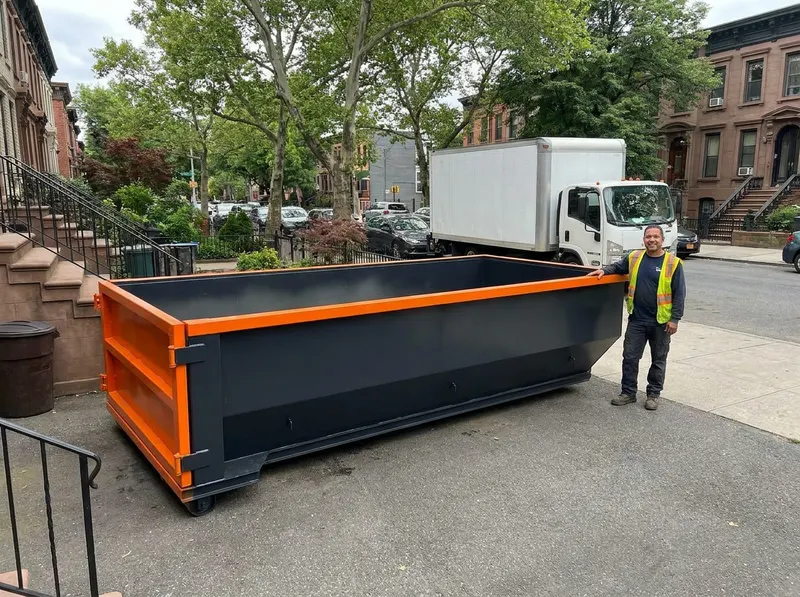
A 10-yard dumpster rental in New York measures roughly 12 feet long, 8 feet wide, and 3.5 feet tall, so it tucks into a short Upper West Side driveway or sits along one parking length on a Harlem side street. The low 3.5-foot walls let you walk heavy debris straight over the side instead of lifting it up and over, which is why the 10-yard is the common pick for a bathroom gut on the Upper East Side or a kitchen tear-out in Hell's Kitchen. A dumpster rental is not junk removal: the container is dropped, you load it on your own schedule, and sustainable materials management principles mean clean wood, metal, and cardboard are easier to divert than mixed loads.
Step 1, confirm the drop spot, a legal curb length or an off-street driveway.
Step 2, a dumpster placed on a New York City street usually needs a street-placement permit from the NYC Department of Transportation, while a private driveway in Washington Heights or Inwood generally does not. Step 3, the roll-off is delivered and set with boards under the wheels to protect pavement. Step 4, you load it.
Step 5, the full container is hauled to a permitted transfer station. For heavier debris, the EPA's construction and demolition debris guidance explains why concrete, brick, and dirt fill the small box fast, those materials are dense, and a 10-yard loaded with clean fill reaches its weight limit well before it looks full.
Choosing the 10-yard comes down to volume versus footprint. If the job is a single-room cleanout, a small bathroom remodel, or roughly 4 truckloads of mixed debris, the 10-yard at $595 is the fit; if a whole-apartment gut or a roof tear-off in Chelsea is coming, a larger box carries the volume for a modest step up, a 15-yard runs $650, a 20-yard $695, a 30-yard $795, and a 40-yard $895.
The trade-off is simple: a 10-yard asks for the least street or driveway space, while a 30-yard asks for far more curb but swallows a full roof's worth of shingles. Clean, heavy material such as dirt, brick, or broken concrete is usually kept to the 10-yard regardless of volume, because weight, not space, governs that load. For jobsite loading, OSHA construction standards cover keeping the work area clear as debris builds.
Recycling drop-off options for leftover electronics and paint are searchable through Earth911, and the EPA's household hazardous waste page lists what cannot go in any roll-off. For material-reuse questions, the Construction & Demolition Recycling Association and the National Recycling Coalition cover diversion practices, and parking-zone rules for a container on a Lower East Side block fall under the NYC parking rules.
Every job gets a firm, written price after an on-site visit.
Tell us about your 10-yard dumpster rental job in New York and we'll send a clear, written quote, usually the same day.
 Heavy Duty Dumpster Rental